PJM's Nov. 16 FERC Filing Would Force 50 MW-Plus Data Centers to Stay on the Grid During Faults
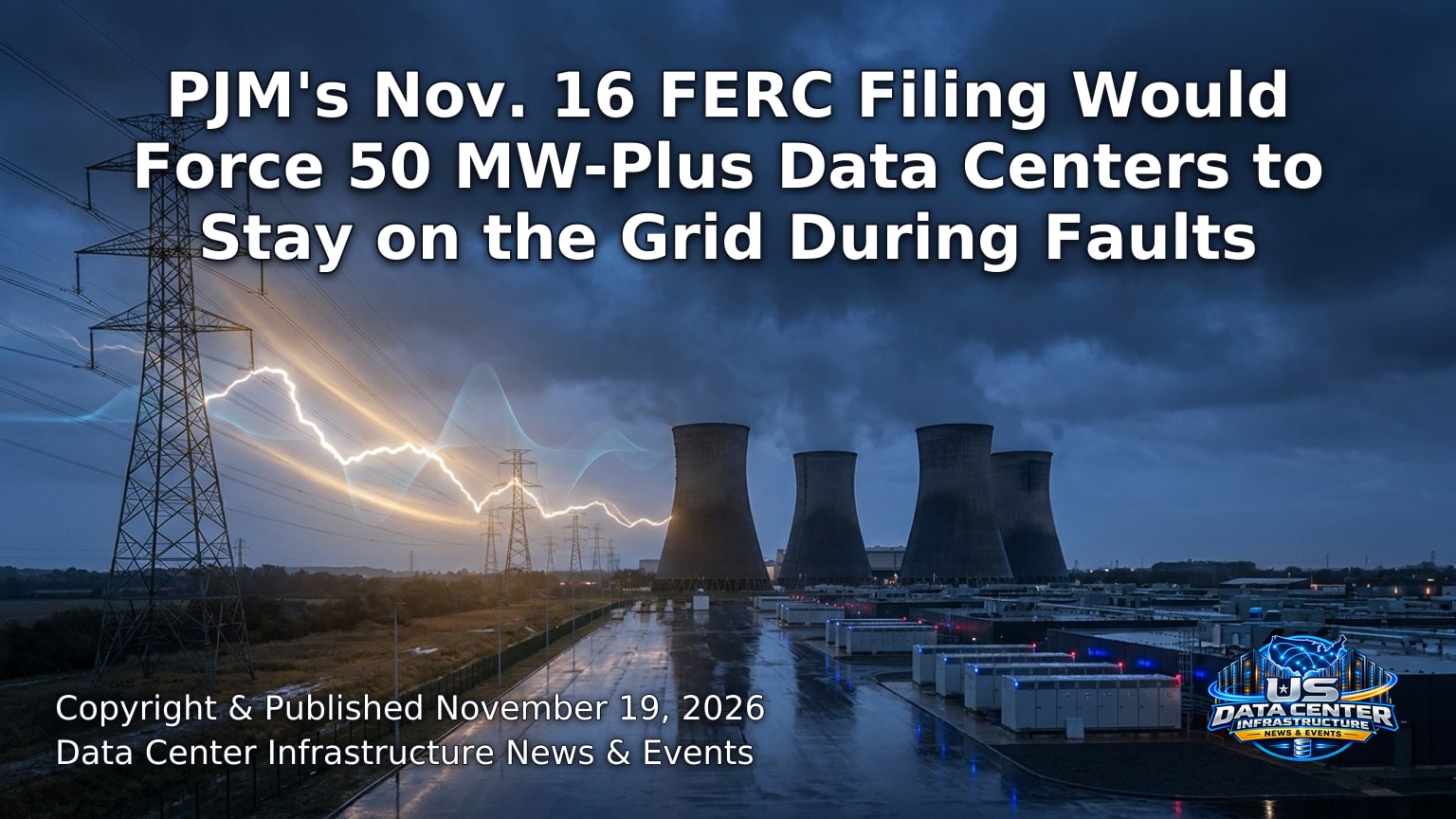
Original illustration created for Data Center Infrastructure News & Events.

PJM's Nov. 16 FERC Filing Would Force 50 MW-Plus Data Centers to Stay on the Grid During Faults
A 230 kV line fault that lasted two to three cycles on the morning of July 22, 2026, knocked roughly 3,800 MW of data center load off the PJM grid in Northern Virginia, according to a PJM Operating Committee presentation published Aug. 6. System frequency jumped to 60.092 Hz and local voltages spiked to 1.138 per unit before dispatchers restored balance nine minutes later. PJM now wants to make sure that never happens again — by requiring the data centers themselves to ride through the next fault rather than switch to backup generation.
The Nov. 16 Filing
PJM filed Docket ER27-531-000 with the Federal Energy Regulatory Commission on Nov. 16, proposing mandatory voltage and frequency ride-through requirements for a new tariff category it calls Large Computational Load, or LCL, according to PJM Inside Lines, published the same day. The category covers any facility with aggregate demand of 50 MW or more that includes at least 25 MW of load served through power electronic conversion equipment, a definition PJM's Planning Committee laid out in an Oct. 6 presentation.
The filing's stated rationale is blunt. PJM's own Nov. 16 Inside Lines writeup states that the July 22 disconnection event "posed serious threats to the reliability and safety of the grid." The tariff revisions carry a declaration from Donnie Bielak, PJM's Director of Interconnection Planning, laying out the technical case for the standard, according to the FERC eLibrary docket entry for ER27-531-000.
Why PJM Calls It Unsustainable
July 22 was not an isolated incident. David Souder, PJM's Executive Director of System Operations, told the September Operating Committee that the event was "unsustainable" and the primary driver behind the new reliability standards, according to a PJM Inside Lines report published Sept. 10. That same report places July 22 as the third measurable load-transfer event of its kind in the region in two years, following transfers of roughly 1,500 MW in July 2024 and again in February 2025.
Each prior event followed the same pattern PJM describes for July 22: a transmission disturbance causes data center load to disconnect and switch to onsite backup generation, which then forces PJM and the local transmission owner — Dominion, in the July 22 case — to manage a sudden imbalance between load and generation on the fly. The ride-through mandate is designed to break that pattern by keeping the load connected through the disturbance instead of letting it fall off the grid at the moment of fault clearing.
Timeline and Who It Covers
The proposed effective date for new LCL interconnections is Jan. 16, 2027, per the FERC filing logged Nov. 16. Legacy facilities — those already interconnected or under construction — get a longer runway: the Oct. 6 Planning Committee presentation sets a compliance deadline of Jan. 16, 2028, or one year after a facility's Commercial Operation Date, whichever is later. That same Oct. 6 presentation states PJM reserves the right to compress that window to 90 days for facilities it identifies as specific high reliability risks, though the presentation reviewed does not specify how that designation gets made or appealed.
That discretion matters for operators sizing new campuses now. A facility crossing 50 MW with 25 MW or more served through inverters, converters or other power electronics — the profile of most hyperscale AI campuses — falls inside the LCL definition by default. There is no exemption in the filing materials for facilities that already have interconnection agreements signed before Jan. 16, 2027; they fall into the legacy compliance track instead.
Paired With Faster Studies and a Transmission Payment Floor
PJM did not file the ride-through mandate alone.
Transmission-owning utilities inside PJM's footprint used the same filing window to push their own financial backstop, and it is the piece of the package most likely to change how a project gets priced. Latitude Media reported Nov. 18 that those utilities are asking FERC to require large loads to commit to paying for at least 80% of requested transmission service for a minimum of 10 years — a contract structure meant to prevent data centers from signing up for transmission capacity, building it, and then switching to self-generation before the utility recovers its cost. Latitude Media's report is the only account of this provision the desk has; it does not name the filing utilities or a docket number separate from PJM's own ER27-531-000 submission. The technical ride-through standard and the 10-year payment commitment target the same failure mode from two directions: one keeps the load physically connected during a fault, the other keeps it financially committed to the infrastructure built to serve it.
Pending at FERC
PJM's filing asks for a Commission order within 120 days — a figure reported by MLQ.ai on Nov. 17 and not corroborated elsewhere in the material reviewed. Utility Dive's Nov. 17 coverage frames the broader package — across PJM and the other grid operators that filed similar large-load reforms the same week — as a response to "show cause" orders FERC issued in June, questioning whether existing interconnection rules were adequate for data center-scale demand growth; Utility Dive's account does not specify a docket number or exact date for those orders. FERC has not yet ruled on ER27-531-000. Until it does, the compliance dates PJM proposed — January 2027 for new LCLs, January 2028 for legacy facilities — remain PJM's request rather than a binding requirement, and the Commission could alter either the definition or the timeline during its review.
What It Means for the Next Project in the Queue
For a developer with a campus already in PJM's interconnection queue, the practical question is which side of the 50 MW and 25 MW power-electronics thresholds the facility lands on, and whether PJM's reliability-risk designation could pull a specific project into the 90-day fast track regardless of its nominal legacy status. For a county weighing a new data center application, the filing adds a federal layer to the due-diligence list: a facility's ride-through compliance plan, and its exposure to the proposed 10-year, 80%-of-capacity payment commitment, now sit alongside the local tax abatement and water permit as line items that determine whether the project pencils.
A fault cleared in two to three cycles — a fraction of a second — pulled 3,800 MW off the grid on July 22 and took PJM dispatchers nine minutes to resolve, according to PJM's own Aug. 6 account. PJM's filing treats that margin as too thin to rely on again. No developer, hyperscaler or trade association has filed public comment on ER27-531-000 yet; the protest deadline on the docket will be the first indication of how the industry plans to push back on the 90-day override and the payment floor.
Links Verified at Time of Publish.
Sources
This article was reported from the following sources.
- PJM Interconnection, L.L.C. submits tariff filing: Proposed Tariff Revisions for Large Loads and Compliance with EL26-67 — Federal Energy Regulatory Commission (FERC) eLibrary, 2026-11-16
- July 22, 2026 Dominion Load Transfer Event - Preliminary Findings — PJM Interconnection (Operating Committee Presentation), 2026-08-06
- PJM Proposes Reliability Standards to Manage Large Load Disconnection Events — PJM Inside Lines, 2026-09-10