The 'Decommissioning Bond' Mandate: Why Counties Are Now Requiring Exit Financing Before Groundbreaking
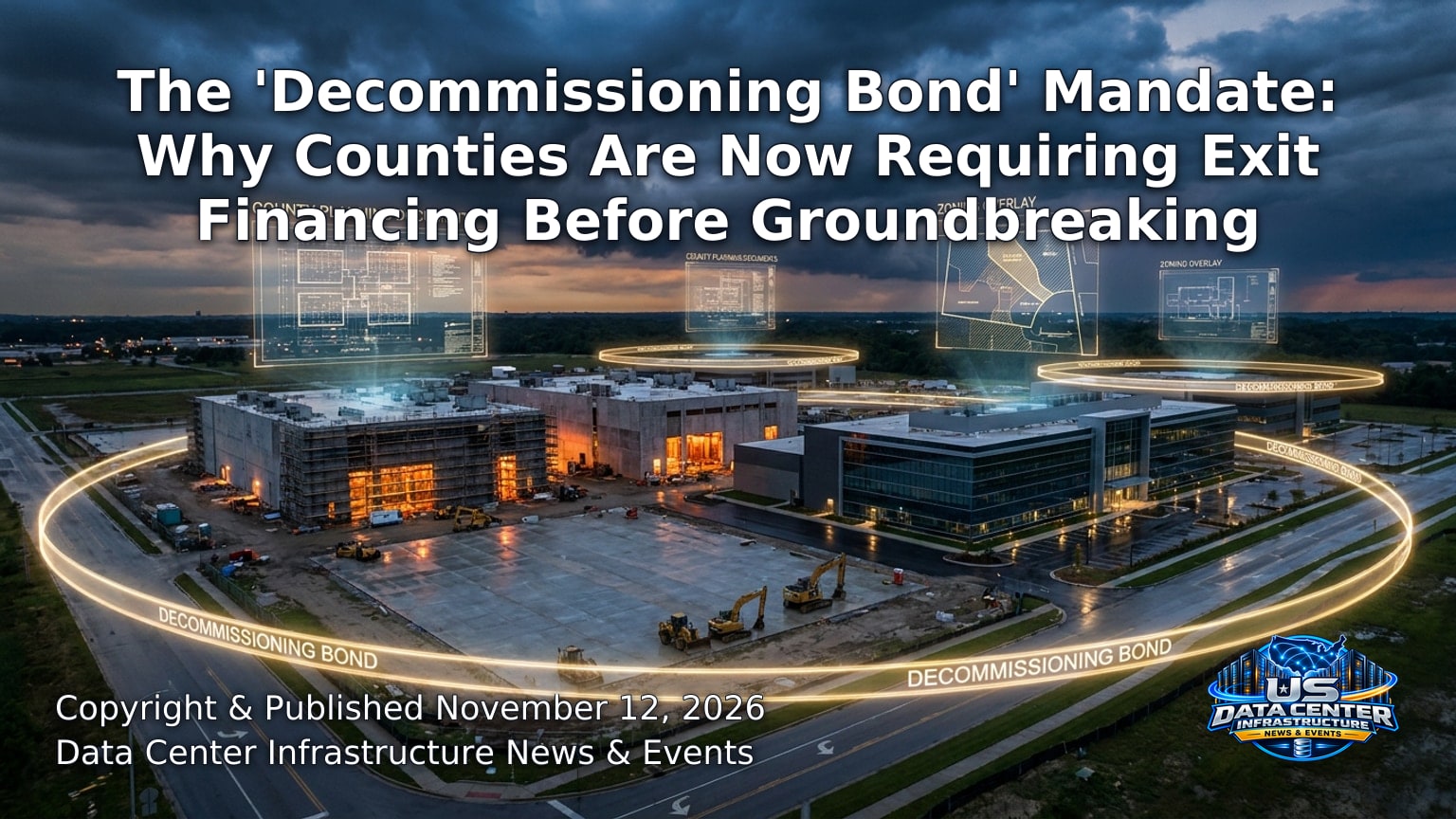
Original illustration created for Data Center Infrastructure News & Events.

The 'Decommissioning Bond' Mandate: Why Counties Are Now Requiring Exit Financing Before Groundbreaking
Loudoun County's zoning ordinance, adopted December 13, 2023, requires every new data center application to carry a financial guarantee — a surety bond or letter of credit — covering 100% of the estimated cost to remove the structure and restore the site if the facility ever closes. The estimate has to come from a professional engineer and gets updated every five years for inflation and salvage value. That single clause has become the template other counties in PJM and MISO are now copying, piece by piece, as the incentive conversation shifts from what a county gives up in taxes to what it gets back if the building goes dark.
Loudoun's language, Prince William's resolution
Prince William County's Board of Supervisors followed five months later. Resolution, passed May 14, directs the county's Planning Office to draft a zoning amendment requiring what the board calls "exit financing," so that an abandoned or obsolete facility does not become a public nuisance or a financial burden on the county. The county's own materials describe the approach as treating data centers as permanent industrial infrastructure requiring end-of-life security, and cite Loudoun's ordinance as precedent.
Virginia's statutory picture is murkier than that resolution implies. SB 513, the bill that would have required developers to submit site-assessment and decommissioning plans, was left in the Local Government committee on February 13, 2024, according to the Virginia Legislative Information System — it never reached the governor's desk. Loudoun's and Prince William's bond requirements rest instead on each county's own zoning ordinance authority: Loudoun wrote its 100%-bond standard directly into Article 5 of its zoning ordinance, and Prince William directed its Planning Office to draft equivalent language rather than wait on Richmond. Neither county has a statewide mandate behind it, which leaves open whether a developer could challenge the bond requirement as exceeding the county's zoning power — a question SB 513 was supposed to settle and didn't.
Ohio sets the number other counties are watching
Licking County, home to the New Albany data center corridor inside PJM, went further than requiring a bond — it set a cost multiplier. Under standards the Licking County Planning Commission adopted June 24, 2024, developers must post a bond before a certificate of occupancy is issued.
Data Center Dynamics reported October 30, 2024, that bond structures now circulating in Ohio and Indiana call for securing 125% of the estimated decommissioning cost in escrow or via surety — a cushion above the raw removal estimate, not just a match to it. The DCD piece frames the shift as counties treating data centers as heavy industry rather than clean tech, explicitly invoking the "Rust Belt effect" — concrete shells left behind once the equipment inside them is obsolete — as the risk planners are pricing against.
Indiana ties the bond to an idle-facility clock
The clearest MISO example is St. Joseph County, Indiana's development agreement with Amazon Data Services for an $11 billion investment. The county didn't require a bond at groundbreaking. It required one to kick in if the facility sits inactive for more than 24 consecutive months — a trigger modeled directly on the county's existing utility-scale solar ordinance. The bond calculation nets a third-party removal estimate against the scrap value of the electrical infrastructure, the same formula the county already applies to decommissioning wind turbines and solar arrays.
That borrowing pattern — pulling bond mechanics from solar and wind ordinances already on the books — shows up again in Illinois. Kane County updated its special use permit criteria for data centers, adding a "Financial Assurance for Deconstruction" requirement. The bond issuer has to carry an A-rating or higher, and the county explicitly modeled the language after its wind farm ordinance, treating substations and cooling towers the same way it treats turbine foundations: industrial assets the developer pays to remove.
The pattern for the next county
Five jurisdictions across two grids have now built bond language in an eight-month span: Loudoun in December 2023, St. Joseph County in April 2024, Prince William in May 2024, Licking County in June 2024, and Kane County in August 2024. None of them invented the mechanism from scratch. Each borrowed from an ordinance already sitting in the county's code — solar in Indiana, wind in Illinois, the engineer-certified removal estimate Loudoun had already used for other non-conforming structures.
A county weighing its first data center application now has four working models to copy rather than one: a flat 100% bond tied to a five-year reappraisal, a 125% escrow cushion against salvage volatility, a 24-month inactivity trigger borrowed from renewable-energy ordinances, or an issuer-rating floor pulled from wind-farm financial assurance rules. The open question none of these ordinances has answered yet is what happens when a bond is actually called — none of the five has reached a closure event, so the enforcement mechanics remain untested on paper rather than in practice.
Links Verified at Time of Publish.
Sources
This article was reported from the following sources.
- Loudoun County Zoning Ordinance, Article 5: Use-Specific Standards (Section 5.06.B.1.k) — Loudoun County Government, 2023-12-13
- Why Data Centers are Being Regulated Like Heavy Industry — Data Center Dynamics (DCD), 2024-10-30
- Virginia SB 513: Data Centers; Site Assessments and Decommissioning — Virginia General Assembly, 2024-02-05