Revenue-Sharing Proposals Test Whether Counties Can Capture Data Center Upside Without New Taxes
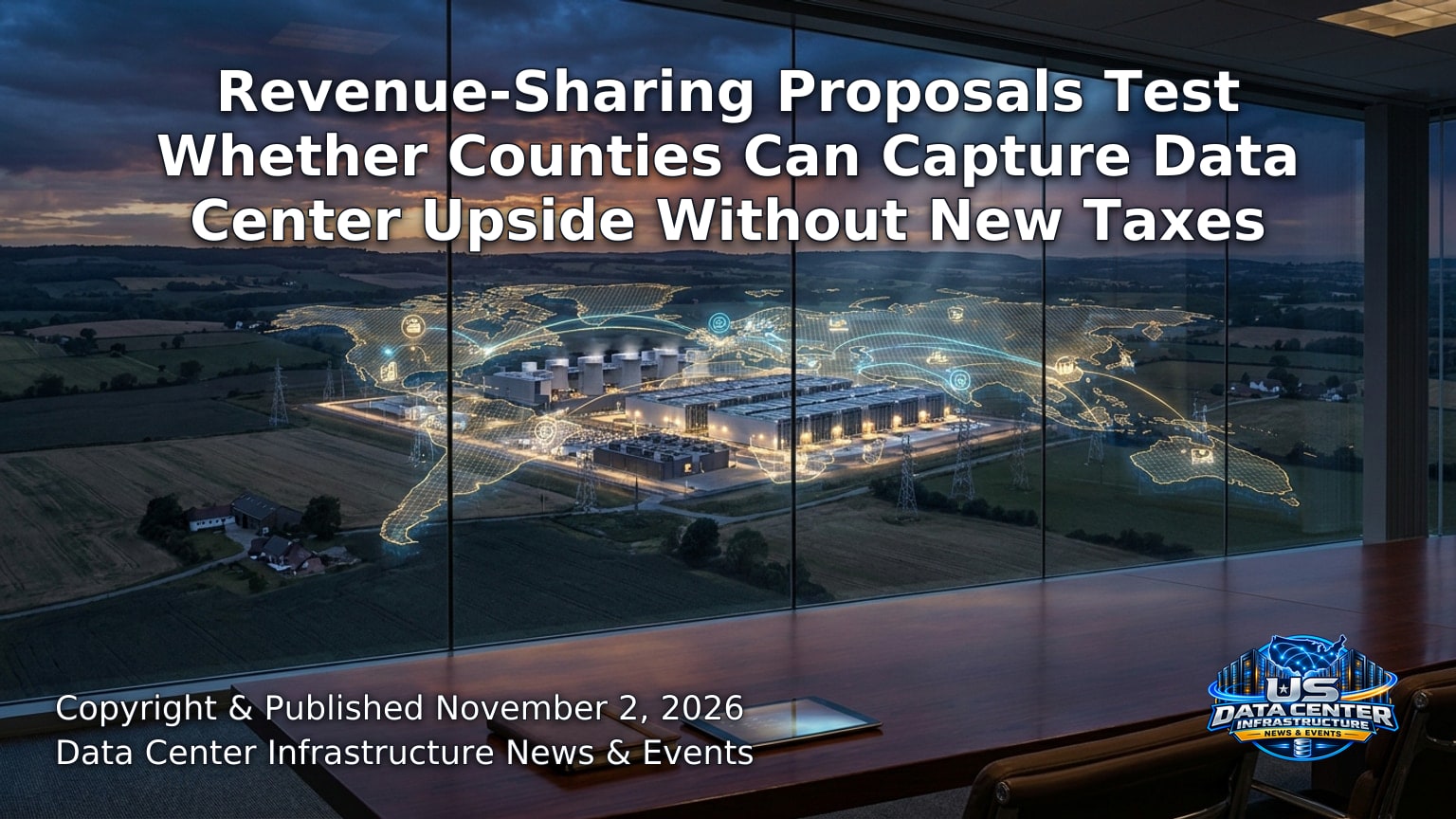
Original illustration created for Data Center Infrastructure News & Events.

A single 1-gigawatt data center generates enough surplus property tax revenue to pay rural households between $4,500 and $8,900 a year without raising anyone's taxes, according to a report the Bitcoin Policy Institute published on September 9, 2026. That figure, attributed to author Sam Lyman, has reached the Oval Office faster than most tax-abatement studies manage in a decade — and it does not match the one real-world payment BPI cites to support it.
The West Feliciana number
BPI's report, titled Data Center Dividends: A Financial Model to Ensure Rural America's Economic Empowerment in the AI Age, builds its case around one Louisiana parish. In West Feliciana Parish, developer Hut 8 agreed to pay approximately $90 million annually to a county of 4,026 households, according to the same September 9 BPI document. That works out to roughly $22,350 per household — two to five times BPI's own $4,500–$8,900 range for a generic 1-gigawatt facility, a gap the report does not explain. West Feliciana is the parish BPI points to as proof the model works; it is not the number BPI is telling other counties to expect.
BPI frames the model as a response to a specific problem: local data center moratoria rose from six in 2024 to 294 in 2026, the institute's September report states. Executive Director Conner Brown has described the goal as a way to bypass traditional "trickle-down" community benefits by putting revenue directly into resident pockets, according to BPI's Q3 2026 quarterly report published October 28.
The White House noticed
Act 434 authorized taxing bodies in the state to return data center revenue directly to residents, according to BPI's October 28 report, giving the dividend model its first statutory vehicle anywhere in the country.
None of that answers what a county board actually negotiates before it votes. The dividend proposal assumes a tax base already exists to redistribute. Most of the deals counties are signing today don't generate one.
What current agreements actually pay
The Federation of American Scientists identified executed Community Benefit Agreements that had been shielded by non-disclosure agreements until researchers pried them loose. The group argues that closed-door negotiation between developers and county officials prevents residents from shaping terms at all, let alone negotiating a per-household cash figure. That is the structural condition a dividend model is designed to override: residents see what the county spent, not what they were paid.
Ownwell's October 14 analysis of 2026 property-tax and power-bill data shows the indirect version of the bargain in practice. Loudoun County, Virginia, cut property taxes by 30% over a decade on the strength of data center revenue, the firm found — the closest thing to a working precedent for broad-based household benefit that predates the dividend proposal. The same report argues public sentiment has turned against indirect relief in favor of direct payments, though it does not name a poll or field dates behind that claim.
Ohio and Illinois paused their data center tax breaks in 2026, according to the same October 14 Ownwell report. A county weighing a dividend clause now has to reckon with the possibility that the abatement it's trading against won't survive the legislative session.
Clawbacks are the other half of the negotiation
The World Resources Institute, in a September 8 report on community benefits agreements, argues CBAs need structured dispute resolution and neutral third-party arbiters if residents are going to capture the upside they were promised rather than the upside a developer projected.
Climate XChange's October 15 toolkit cites Illinois HB5513 as a parallel approach. The toolkit frames this as the clawback complement to any dividend structure — a mechanism to recoup exempted taxes if a developer misses employment or investment commitments already written into the deal.
That is the piece county negotiators will need before a dividend clause means anything. A fixed share of property tax revenue paid to households only exists if the abatement that created the surplus has enforcement teeth behind it. Illinois's proposed fee fund is another.
The federal backstop and its limits
The White House's Ratepayer Protection Pledge, issued March 4, 2026, calls on hyperscalers to "build, bring, or buy" all energy needed for their data centers so that costs don't land on ordinary households. The pledge asks companies to voluntarily negotiate separate rate structures with utilities and state governments rather than socializing infrastructure costs across the ratepayer base. It addresses the power side of the bargain. It says nothing about whether a county's property tax surplus gets redistributed, clawed back, or spent on county services nobody votes on.
Thirteen states, one November
Voters in thirteen states will decide data center ballot measures in November 2026, ranging from outright development bans to new zoning restrictions, according to Agri-Pulse's October 28 report. Agri-Pulse frames the underlying question as whether counties can capture enough revenue to offset strain on electricity and water without imposing new taxes on residents, where BPI starts from a developer payment and asks how to distribute it, while the ballot measures start from community resistance and ask whether to permit the facility at all.
A county weighing its first large data center proposal now has two templates circulating at once: Louisiana's statutory dividend mechanism under Act 434, and the closed-door CBA model that FAS says still governs most existing deals. No county has combined all three — a mandated household payment, an enforceable clawback, and public disclosure of the negotiated terms — into one package. That combination is what the next vote will have to produce if a dividend clause is going to survive contact with an actual abatement application.
Links Verified at Time of Publish.
Sources
This article was reported from the following sources.
- New Report: Surplus Tax Revenue from a Single Data Center Could Pay Every Household in a Rural County Up to $8,900 a Year — PR Newswire, 2026-09-09
- Data Center Dividends — Bitcoin Policy Institute, 2026-09-09
- BPI Quarterly Report - Q3 2026 — Bitcoin Policy Institute, 2026-10-28
- What’s with all the secret data center agreements? — Federation of American Scientists, 2026-10-20
- Powering Progress: How Community Benefits Agreements Can Drive Responsible Data Center Development — World Resources Institute, 2026-09-08
- How data centers are rewriting homeowners’ property tax and power bills in 2026 — Ownwell, 2026-10-14
- Trump reportedly backs 'Data Center Dividends' proposal — Digg, 2026-10-03
- Data center ballot measures put economic benefits, community costs in focus — Agri-Pulse, 2026-10-28
- Ratepayer Protection Pledge — The White House, 2026-03-04
- Tax, Employment, and Economic Impacts State Policy Toolkits for Data Center Regulation — Climate XChange, 2026-10-15