Voters Reject Data Centers in 40 of 41 Local Ballot Measures on Nov. 3
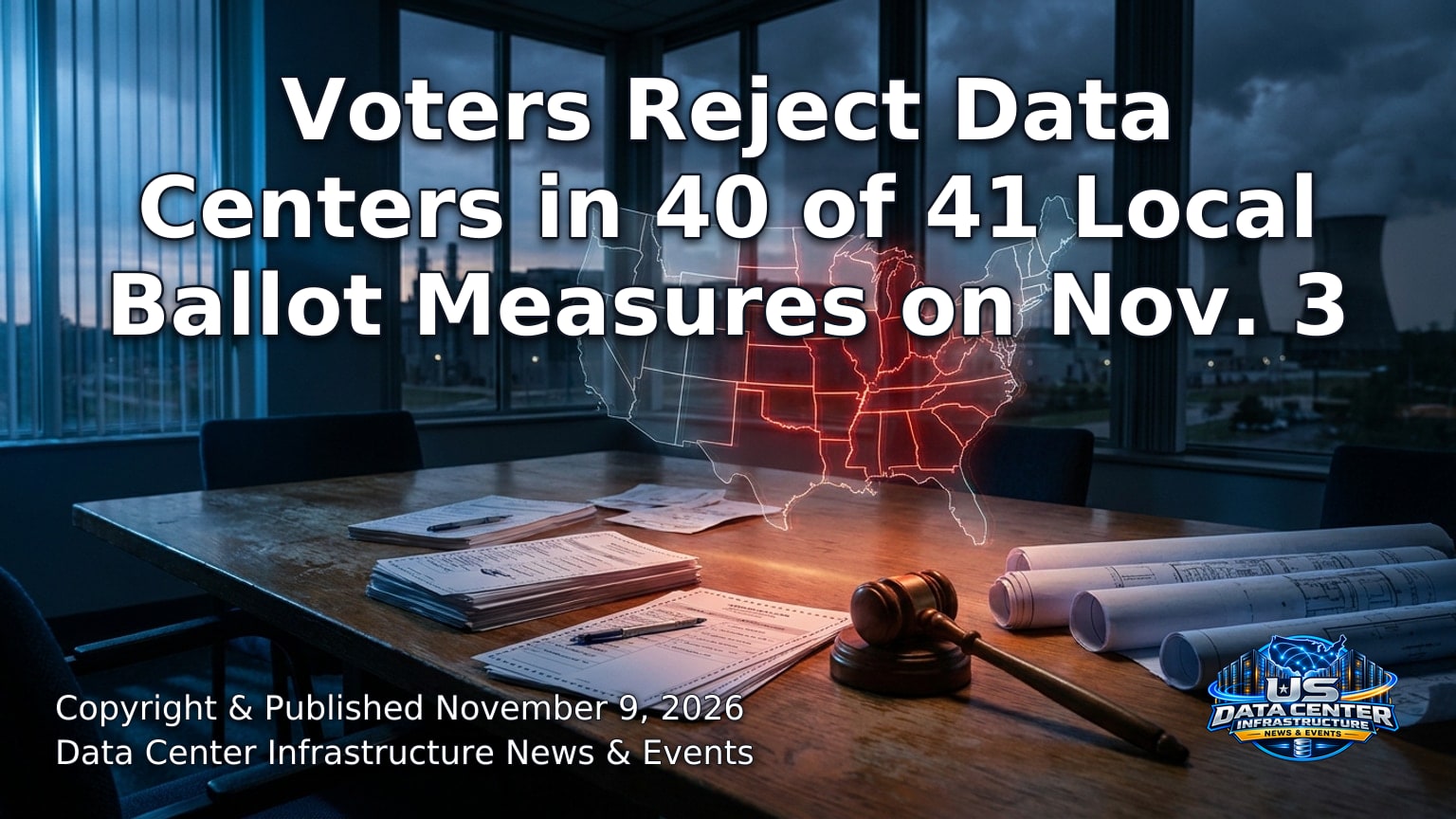
Original illustration created for Data Center Infrastructure News & Events.

Texas Flips, and Goldman Puts a Number on What's at Stake
Goldman Sachs chief economist Jan Hatzius estimated that states positioned to add data center restrictions after the November 3 election now hold roughly 45% of planned U.S. data center capacity, Business Insider reported November 4. That estimate landed the same week Texas Governor-elect Gina Hinojosa unseated incumbent Greg Abbott after pledging an immediate moratorium on new data center development, Bisnow reported November 5. Abbott had marketed Texas as the "epicenter of AI development."
MOCA Systems Chief Economist Brandon Michalski described the broader pattern to Bisnow as "whack-a-mole" from the electorate against the industry, a characterization that fits a map where opposition kept surfacing in new jurisdictions after each local win elsewhere.
40 of 41 Local Measures Went Against the Industry
Voters in ten states decided the fate of new data center development at the ballot box on November 3, and 40 of 41 local measures came back against the industry, according to Ballotpedia, which published its count on November 6. The lone exception was Harwood, North Dakota, where a proposed review requirement failed.
Ballotpedia counted five full bans — in California, Florida and Ohio — plus twelve partial bans and three six-month moratoriums; the remaining passed measures were not broken out by category in Ballotpedia's release.
The Largest Wave on Record
Duane Morris Government Strategies, which tracks data center ballot activity nationally, called November 3 the largest wave of local data center votes on record in a November 4 report, putting the same night's count at 41 measures. The firm's report does not say whether that count was built independently or drawn from Ballotpedia's own tally. It does add context Ballotpedia's release did not: 2026 has now produced 50 local data center measures across 13 states, with 46 of them resulting in restrictions.
Ohio Adds to an Existing Pile of Moratoriums
Ohio voters in 18 municipalities decided 21 separate measures on November 3, with at least 14 passing bans or restrictions, according to Fortune's November 4 report. The state already had 125 local data center moratoriums in place before the election.
Keith Durkin, a director at the Ohio Northern University Institute for Civics and Public Policy, told Fortune the turnout signals that "ratepayer protections, transparency, and grid safeguards should dominate policy agendas" nationwide.
Trenton voters backed a ban on large data centers, CIO Africa reported November 6. Sunbury voters approved a charter amendment banning facilities of 25 megawatts or more, the same report said. Wilmington voters rejected land rezoning for data centers across four separate referendums on the same ballot.
Florida and California Margins
Outside Ohio and Texas, opposition also carried the coasts. Edgewater, Florida, voters approved a ban on new data centers, Truthout reported November 6. Alhambra, California, voters endorsed a similar restriction the same night, per the same report.
Money and Messaging Behind the Vote
The results did not happen in a vacuum. Democrats spent more than $100 million on broadcast ads casting Republican opponents as "overly cozy" with Big Tech and data centers, TIME reported November 4, contributing to wins in Ohio, Kansas and Iowa. An NBC exit poll cited in the same report found 56% of voters called AI and data centers a "crucial or major factor" in their congressional vote. TIME also reported that Annie Andrews defeated Darline Graham after nicknaming her opponent "Data Center Darline."
Darrell West, a senior fellow at the Brookings Institution, told the Philadelphia Inquirer in a November 6 report to "expect a tsunami of new rules and oversight" following the results, framing the vote as a rejection of the federal "hands-off approach" to siting that had prevailed through most of the AI buildout. hngnews.com reported November 6 that an AP Voter Poll found 75% of U.S. voters oppose new data centers in their communities, and called Hinojosa's win the single most important result for the industry nationally.
OpenAI's Rebrand Didn't Move Voters
Industry tried to get ahead of the vote. OpenAI rebranded its data centers as "compute campuses" on November 1, Business Insider reported that day, two days before the election. The rebrand didn't change the outcome. On November 5, OpenAI announced a National Community Compact and a Compute Campus Policy Blueprint, Inc. reported, acknowledging the need to "listen to and react to" voters' demands for transparency and oversight — language that reads as a response to the ballot results rather than a plan drafted before them.
Environmental Justice Groups Claim a Role
The opposition wasn't limited to utility bills. Jamil Davis, an organizer with Black Voters Matter in Florida, told Capital B News in a November 4 report that utility bills and data centers were the primary issues residents raised during door-knocking. Capital B framed the national result as a continuation of environmental justice organizing, citing the influence of Memphis-based groups including Memphis Community Against Pollution.
A Thinner Number Worth Watching
A Bloomberg video report cited by shattered.io on November 8 put public opposition to data centers at 75%, up from 42% a year earlier, and put $690 billion to $725 billion in AI capital expenditure against that shift. The figure rests on one aggregator's summary of a Bloomberg segment rather than a published dataset, and it should be treated that way until a primary filing or transcript confirms it.
Links Verified at Time of Publish.
Sources
This article was reported from the following sources.
- Voters favored limiting data center development in 40 of 41 local ballot measures on Nov. 3. — Ballotpedia, 2026-11-06
- Data Centers on the Ballot: Where Things Stand — Duane Morris Government Strategies, 2026-11-04
- Ohio just poured onto its existing 125 data center moratoriums. — Fortune, 2026-11-04
- How AI Backlash Shaped the 2026 Midterms — TIME, 2026-11-04
- Data Center Industry Reckons With New Roadblocks After Electoral Wipeout — Bisnow, 2026-11-05
- Voters rejected AI in the midterms. Now comes an era of scrutiny. — The Philadelphia Inquirer, 2026-11-06
- Voters revolt against AI buildout and tech titans at ballot box — Axios, 2026-11-04
- The GOP Wasn't the Only Midterms Loser. Voters Slapped Data Centers With Limits. — Truthout, 2026-11-06
- OpenAI Tried to Rebrand Its Data Centers. Voters Rejected Them Anyway — Inc. Magazine, 2026-11-05
- Voters Reject Data Centers in 2026 Midterm Elections — Capital B News, 2026-11-04
- 41 Data Center Votes Put the AI Boom on Notice [2026] — shattered.io, 2026-11-08
- Ohio Voters Push Back Against The AI Data Center Boom — CIO Africa, 2026-11-06
- AI data centers took a beating in the midterm elections. — hngnews.com, 2026-11-06
- US Election Results Signal Growing Public Backlash Against AI Expansion — NewsHack, 2026-11-08