Texas, Illinois and Michigan Are Making Grid Access Conditional on How a Data Center Cools Itself
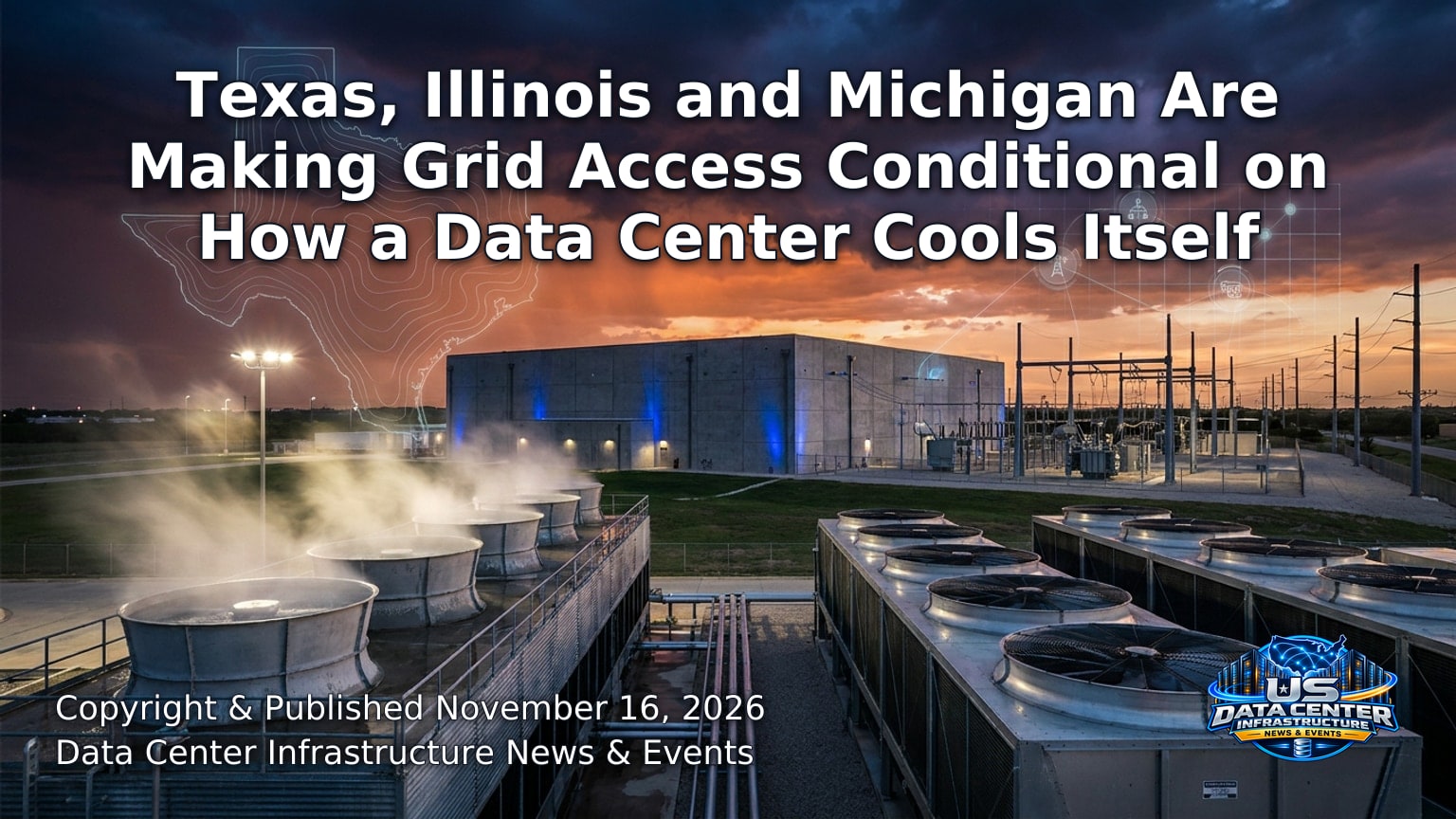
Original illustration created for Data Center Infrastructure News & Events.

Texas, Illinois and Michigan Are Making Grid Access Conditional on How a Data Center Cools Itself
Senator Charles Perry filed SB 338 in the Texas Senate on November 12, 2026. The bill, filed as Texas SB 338 of the 90th Legislature, would "bar new data centers from connecting to the state's main power grid unless they cool their computers with systems that use little or no fresh water." The Texas Dispatch reported on the filing November 15, 2026. A developer seeking an ERCOT interconnection would first have to commit to closed-loop recirculating cooling, dry cooling, saline water or another low-water method, then file annual cooling-water estimates with the Public Utility Commission, which passes them to the Texas Water Development Board.
None of that is law yet. What already governs interconnection in Texas is two actions taken in September. The Public Utility Commission of Texas adopted final large-load interconnection standards under 16 TAC §25.194 on September 18, 2026. Three days later, on September 21, Governor Greg Abbott directed the Texas Commission on Environmental Quality to suspend data center permits pending combined grid and water audits. Those two actions are in effect now and already control whether a 75 MW load gets connected. SB 338, Illinois's pending bills and Michigan's proposed statutes are not.
Texas is running two tracks at once
The PUCT's September 18 order set the 75 MW threshold for large-load interconnection review; NFM Consulting's September 28 summary lays out how that threshold is applied to project queues. Abbott's directive, issued three days after the order, ties TCEQ's environmental permitting — the permit a cooling system needs — to that same 75 MW line, so a facility now clears or fails a combined audit rather than two separate reviews.
The legislative filings that followed ran in the order the audits implied. Representative Salman Bhojani filed HB 529 first, on November 9, 2026, requiring any facility pulling 75 MW or more to file a water resource impact assessment naming every source of supply and requiring TCEQ to hold public hearings in host counties before the facility can close out its grid connection, per The Texas Dispatch's November 16 report. Perry's SB 338 followed three days later. Where HB 529 sets a disclosure-and-hearing gate, SB 338 sets a technology mandate — no interconnection without low-water cooling. Both attach to the same 75 MW line the PUCT already uses for interconnection review, and both would sit on top of audits that are already running.
Texas was already requiring water paperwork on the generation-financing side. Under the Texas Energy Fund rules at 16 TAC §25.510 — the code provision as published August 4, 2025 — applicants for dispatchable generation loans must submit a description of fuel and water supply arrangements, including evidence of water rights and permits, before the state will fund the plant serving that load. HB 529 and SB 338 would extend the same logic — water paperwork as a precondition for power access — from generation financing to load interconnection.
Illinois ties the permit to the discharge pipe, not just the intake
Illinois's approach came from the other direction. SB 3830's text, as tracked by the Illinois General Assembly in a status record dated May 22, 2026, would require every data center operating in the state to identify likely pollutants in its water discharges and begin EPA-monitored reporting starting January 1, 2027. The General Assembly's record does not state whether the bill has cleared committee or either chamber; what is confirmed is the text and the January 1, 2027 compliance date it sets. That rule reaches the cooling loop on the outflow side — what a chiller plant returns to a municipal system — rather than the intake side Texas is regulating.
The POWER Act, filed as SB 4016, builds a second layer on top of that. As of November 13, 2026, when it picked up co-sponsorship from Senator Doris Turner, the bill establishes Water Impact Permits for hyperscale facilities, mandates water resource planning and quarterly usage reporting, and amends both the Public Utilities Act and the Illinois Power Agency Act so that a data center must clear a water scarcity plan and meet specified energy codes before it gets operational approval. Illinois has effectively built a stack: discharge monitoring under SB 3830, intake and usage planning under the POWER Act, both sitting ahead of the utility approvals a facility needs to switch on.
Michigan is still writing the rulebook
Michigan has not consolidated its approach the way Texas and Illinois have. HB 6426, the Data Center Local Decision Protection Act, was introduced in October 2026 according to LawSignals' October 1 roundup of the state's 36-bill package — a count that rests on that single legal-industry newsletter and has no corroborating legislative tally in this reporting. The bill would require large-scale facilities to submit energy demand, water use and environmental impact data for a 30-day public review before an application is even considered administratively complete.
Governor-elect Jocelyn Benson went further. On November 10, 2026, she proposed a moratorium on new data center construction until developers meet new standards on community transparency, environmental protections and energy costs, citing strain on local water tables, according to ClickOnDetroit's report the same day — the only outlet in this reporting to carry the proposal. Separately, Senate Bill 1046, introduced in June 2026 per Miller Canfield's October 30 analysis, would require the Department of Environment, Great Lakes, and Energy to publish annual water-use reports for data centers. Miller Canfield notes Michigan still operates under the common-law Reasonable Use Doctrine for groundwater, but the legislative direction is toward permitting and cost-allocation rules that force a developer to prove its water draw will not unreasonably interfere with adjacent users before site plan approval.
One consultancy's national count, and what it doesn't show
SLR Consulting, in a report published September 30, 2026, counted more than 60 bills introduced across U.S. states in 2025 and 2026 targeting data center water use, with "at least 12 states" considering closed-loop mandates. That figure is SLR's own tally; the report does not publish a bill list or a counting methodology, and no independent legislative tracker in this reporting corroborates either number. SLR also flags Illinois's POWER Act as setting an efficiency benchmark rather than an outright technology ban, and says Kansas and South Carolina are moving toward rules that would bar municipal water from cooling systems entirely — again without naming specific bills, chambers or dates. The distinction between a benchmark and a ban still matters for a developer comparing states: one leaves room for engineering trade-offs, the other doesn't. Whether Kansas and South Carolina have actually filed bills that do this is not established here.
For a county weighing its first large-load application, the fact that governs the next twelve months is the one already in force: Texas regulators merged water review and interconnection review into a single sequence on September 18 and 21, before any of the four state legislatures had finished writing their bills.
Links Verified at Time of Publish.
Sources
This article was reported from the following sources.
- SB 338: 16 Senators Tie Data Center Grid Access to Water — The Texas Dispatch, 2026-11-15
- Texas SB 6 Large Load Rules: What Data Centers Must Know About ERCOT Interconnection, Curtailment, and Ride-Through in 2026 — NFM Consulting, 2026-09-28
- Illinois SB4016 | 2025-2026 | 104th General Assembly — LegiScan / Illinois General Assembly, 2026-11-13
- Michigan data center and energy bills 2026: 36 pending bills — LawSignals, 2026-10-01
- Michigan data centers: Governor-elect Jocelyn Benson proposes new regulations on water, energy, tax breaks — ClickOnDetroit, 2026-11-10
- 16 Tex. Admin. Code § 25.510 - Texas Energy Fund In-ERCOT Generation Loan Program — Texas Administrative Code, 2025-08-04
- Zero-water cooling mandates could leave America thirstier — SLR Consulting, 2026-09-30
- HB 529 Would Make Data Center Water Use Public — The Texas Dispatch, 2026-11-16
- Data Center Water Use Legislation in Michigan, Illinois, and California — Miller Canfield, 2026-10-30
- Illinois General Assembly - Bill Status of SB3830 — Illinois General Assembly, 2026-05-22