Pennsylvania Candidates Push Self-Supply Rules for Data Center Power and Water Ahead of Local Ordinances
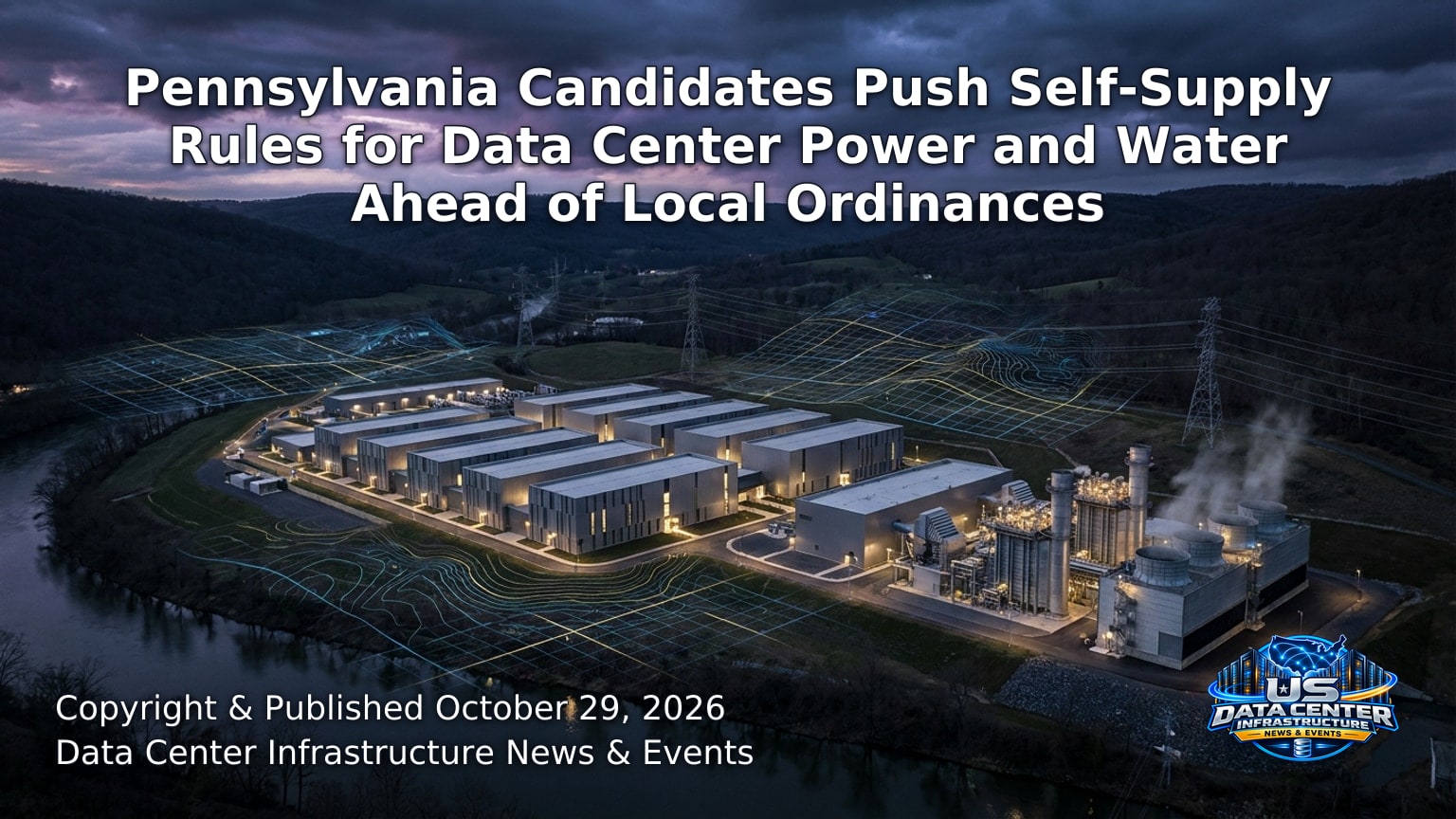
Original illustration created for Data Center Infrastructure News & Events.

Pennsylvania data center developers will now have to put new generation on the PJM grid themselves, inside the same load pocket where they're building, before the state will let them break ground. Governor Josh Shapiro's Executive Order 2026-05, signed August 18, 2026, is the first state-level rule in Pennsylvania to reach into a project's power supply rather than just its siting and water use, according to the Commonwealth of Pennsylvania's release on the order.
What the order actually conditions
The order sets up two separate gates, not one. The Department of Environmental Protection will not review a permit application for any data center over 25 MW unless the developer has made a "legally binding commitment" on energy affordability, water conservation and community engagement, per the Commonwealth's release. Separately, even a project that clears DEP review cannot get its state permit issued until it has secured local municipal approval, and the order bars the non-disclosure agreements that have kept project terms out of public hearings in several counties this year. One gate unlocks DEP's review; the other unlocks the permit itself. A county solicitor now has leverage at both points.
The generation language is where the order will be felt first on a term sheet. A legal analysis published by Greenberg Traurig on August 20, 2026, found that the order requires developers to meet project demand through new or incremental generation sited within the same PJM Locational Deliverability Area as the facility. The order also shifts transmission and interconnection costs directly onto the operator rather than the ratepayer base, the firm's analysis found.
The precedent the order is writing around
Pennsylvania already has a live test case for self-supply at the Talen Energy–Amazon site on the Susquehanna nuclear plant. FERC rejected an amended interconnection service agreement that would have raised co-located load there to 480 MW in late 2024, according to background reporting from DistroForge published August 25, 2026; the arrangement continues to operate under an existing 300 MW agreement. DistroForge is the only account of that dispute available here, and its further claim that the rejection survived a January 2026 appeal has not been confirmed against a FERC docket or any other outlet, so it is not repeated as fact. The state's interest in broader "Eligible Load" and behind-the-meter generation rules follows that dispute in time; EO 2026-05's in-LDA generation requirement writes self-supply into the permitting process itself, rather than leaving every arrangement to a case-by-case interconnection fight at FERC.
Where the governor's race lands on this
The order arrives in the middle of a governor's race where the two leading candidates disagree on whether the state should be setting rules at all. Spotlight PA's July 7 comparison of the candidates found Shapiro favoring voluntary environmental and energy standards tied to incentives, while Republican challenger Stacy Garrity is campaigning on a pause on new data center development paired with mandatory rules confining projects to industrial and brownfield land. Garrity's position predates the executive order by six weeks. The order itself does not pause anything; it conditions permitting on commitments signed before construction, a narrower and faster mechanism than a moratorium.
State senator Jarrett Coleman has a narrower tool moving through the legislature. His Senate Bill 1345 would let a municipality impose an 18-month moratorium on data center applications by resolution, giving local governments time to update zoning on power supply, water consumption, noise and setbacks before new projects come in. That is an opt-in tool for a single township, not a statewide freeze, and it leaves the decision with the municipality rather than Harrisburg.
What counties have already locked in
Two county-level actions this spring show what mandatory terms look like once they are signed rather than proposed. Franklin County Commissioners adopted an amendment to the county's Subdivision and Land Development Ordinance on May 20, 2026, requiring water impact studies and electrical service verification before a data center project can proceed, along with noise limits and financial security for eventual decommissioning — a model built, in the county's words, to help municipalities "prepare, rather than react" to proposals.
Lancaster went further on substance. The city's Community Benefits Agreement, summarized by the City of Lancaster on May 28, 2026, caps data center water use at 20,000 gallons per day per campus, mandates closed-loop cooling to limit municipal water draw, and requires 100% clean-energy electricity for all buildings on site, with a financial penalty into the city's Sustainable Development and Clean Energy Fund if the clean-energy target is missed. That is the closest thing in the state to the self-supply and clean-power terms EO 2026-05 now imposes statewide, except it was negotiated and signed rather than ordered from Harrisburg.
Where the next ordinance is being written
Radnor Township is drafting rules that borrow from both the Franklin County and Lancaster approaches. The Philadelphia Inquirer reported on October 27, 2026, that commissioners are advancing a draft ordinance confining data centers to specific office park districts and requiring water, thermal impact and power feasibility studies before township approval. Zoning officer Megan Donovin told the Inquirer the goal is to "maintain as much local control as possible" and to avoid "purpose-built, hyper-scale facilities" near residential neighborhoods.
The politics around these ordinances are now shaping legislative races, not just county agendas. WHYY's October 22, 2026 reporting on the state Senate District 24 contest in the Philadelphia suburbs found candidates from both parties running ads built around opposition to unregulated data centers, with hyperscale proposals in Limerick Township as the central issue. Resident Chrissie Dziembowski told WHYY the fight has "brought together people from every party," with grid reliability and local environmental impact as the shared complaint.
The platform furthest from current law
Mark Pinsley, running for state Senate District 16, has staked out the most restrictive position reported so far. The Bucks County Beacon's August 11, 2026 coverage describes his call for a statewide moratorium on new data centers until the legislature codifies strict rules, a clean-power standard requiring newly built renewable generation rather than purchased credits, and what he calls "water rules, not just water reports" — a ban on using drinking water for cooling wherever an alternative exists. That standard is stricter than anything currently in force. Lancaster's CBA caps withdrawal and mandates closed-loop systems but does not ban drinking-water cooling outright.
What changes for the next county
A county weighing a data center application now has three reference points instead of one. It can require the water and electrical verification studies Franklin County wrote into its SALDO in May. It can negotiate a binding gallons-per-day cap and a clean-energy penalty clause along the lines of Lancaster's CBA. And under EO 2026-05, a project over 25 MW needs a signed binding commitment on energy, water and community terms before DEP will even review the application, and needs local municipal approval before the state will issue the permit — two separate points of leverage that did not exist in state rule before August 18.
What remains unresolved is whether state legislation will make any of this mandatory statewide, or whether SB 1345's opt-in moratorium becomes the default path for counties that want time to write their own version of the Franklin or Lancaster terms before a developer shows up with a signed term sheet.
Links Verified at Time of Publish.
Sources
This article was reported from the following sources.
- Governor Shapiro Signs Executive Order on Data Center Development in PA — Commonwealth of Pennsylvania, 2026-08-18
- Where Shapiro and Garrity stand on Pennsylvania data centers — Spotlight PA, 2026-07-07
- Pennsylvania Senate Advances Bill Allowing 18-Month Data Center Moratoriums — Washington Bureau / Telecom150, 2026-07-13
- Data Center Ordinance - Franklin County — Franklin County, PA, 2026-05-20
- Community Benefits Agreement Summary - City of Lancaster, PA — City of Lancaster, 2026-05-28
- Gov. Shapiro Issues Executive Order 2026-05 Imposing New Requirements on Pennsylvania Data Center Projects — Greenberg Traurig LLP, 2026-08-20
- How data center battles in the Philadelphia suburbs could impact party control of the Pa. legislature — WHYY, 2026-10-22
- Amazon's Susquehanna Data Center Campus: A 1.92 GW Nuclear Bet in Pennsylvania — DistroForge, 2026-08-25
- What rules does Pennsylvania put on data centers, and what would Mark Pinsley add? — Bucks County Beacon, 2026-08-11
- Radnor is weighing strict regulations on data centers as the facilities crop up across Pa. — The Philadelphia Inquirer, 2026-10-27